
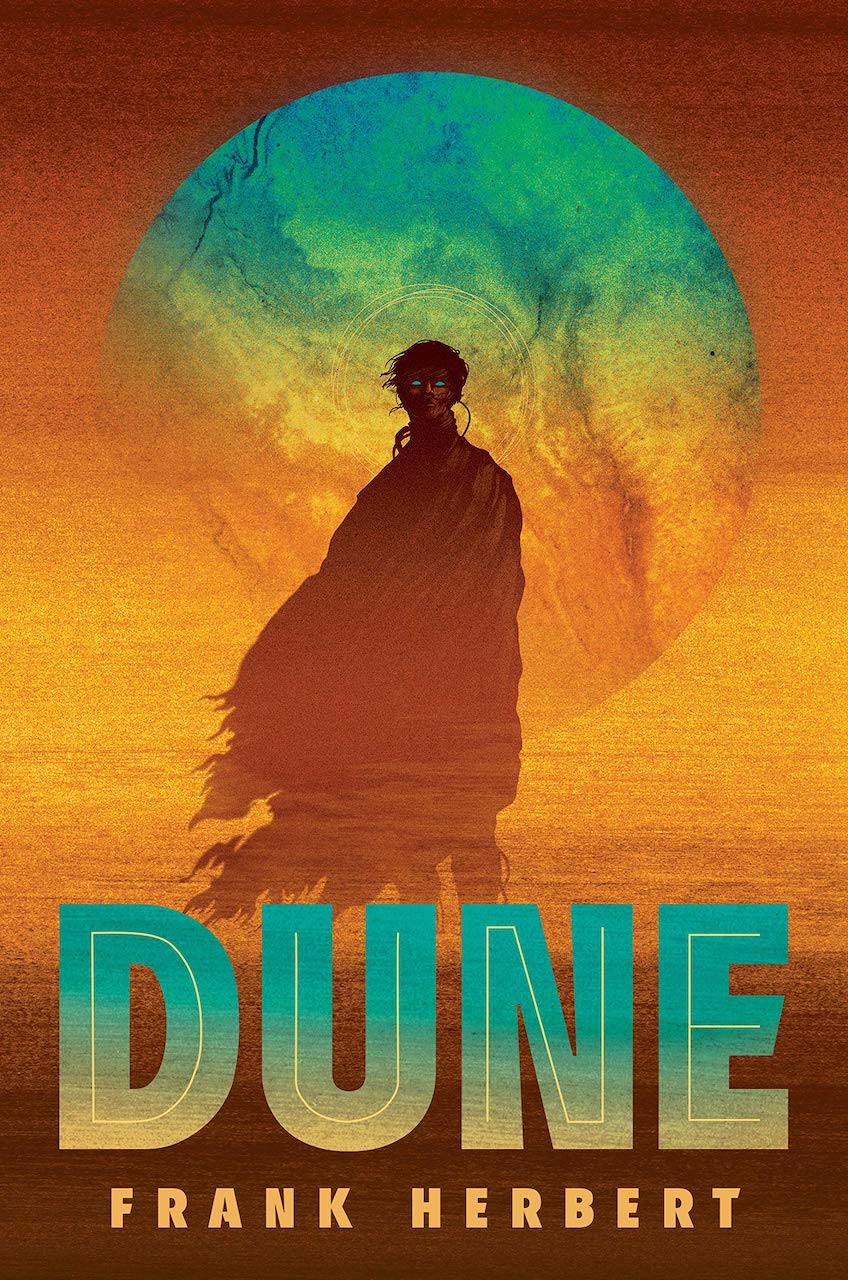
A Mini Review of Frank Herbert’s “Dune” by James FitzRoy
At first glance, it seems odd to call Dune a science fiction novel; although it includes planets and space ships, it is firmly rooted in fantasy. Yet pure science snakes like worms through the sands of Arrakis. With planetary ecology, it’s considered ahead of its time in dealing with issues now vital to the survival of our world. “Ecology is the science of understanding consequences.”1.
Herbert did six years of research on ecology and the fluid dynamics of deserts. He conceived a long novel depicting the rise of a noble but apocryphal leader, which became the first Dune trilogy2. In this, Paul Atreides closely follows the tradition of desert prophets from Moses to Mohamed. It is woven with inspiration from the teachings of Islam: As warrior prophet, Paul leads a desert society to military victory, while the word Jihad is used to describe a religious or fanatical crusade.3
The book opens playfully with a quote from the Princess Irulan, echoing a fairytale’s ‘One Upon A Time’.4 In third-person omniscient, we are already on the move; House Atreides is shipping to Arrakis at the behest of the emperor. Starting with momentum, the stage is set for characters struggling through labyrinthine manipulation.
More Game of Thrones than Star Trek, Dune seems entrenched in fantasy tropes. In science fiction, the future usually portrays humanity as progressive and secular; turning from religion to scientific logic. Instead we see a medieval feudal system with dukes, barons and fiefdoms where control passes to the next relative in succession. Inheritance and royal nepotism have proliferated, propped-up by a breeding program between the Houses. Supremely woven into this fabric, religion is not enlightenment but another form of control by a select few.5
All branches of power orchestrate for the betterment of their agenda; the imperial centre and Houses, CHOAM company, even the Bene Gesserit who claim to serve, secretly operate a shadow government, weaving their tapestry through bloodlines. Through an extensive breeding program, their goal is to place a Bene Gesserit on the throne. The arrival of this leader has been primed through generations of fabricated legend (the ‘Missionaria Protectiva’); a leader who will free oppressed on developing worlds like Arrakis. But this plan backfire when Duke Leto’s concubine gives him a son rather than the planned daughter and, a generation too soon, Paul becomes their legendary Quizatz Haderach.
After departure from Caladan, almost all the action takes place on Dune. Officially known as Arrakis, it contains vast deserts, a desperate lack of water and is patrolled by colossal sand worms attracted to rhythmic movement. Yet it’s the only home to Spice; a consciousness-expanding drug that can extend life, give the user prescience, and is the backbone of interstellar travel. Much like oil for the modern world, the empire is in endless conflict over domination of this world and its Spice.
There is an ominous shroud that covers the story of struggle and survival; dramatised scenes are weighty in tone with little humour. Its science filters through the connective tissue of dialogue without the need to halt the action.6 In a powerful scene, imperial ecologist Kynes is cast without Stillsuit into the desert and certain death. Here, he has a conversation with his dead father and a revelation about the world.7
In describing the world and its technology, the prose is exquisite, carrying weight through name or action; The carryall; the crawler; the ornithopter… A description of the ornithopter, for example, is done through its action in the world, with short punchy sentences providing a quick feel for the object in motion.8
Adding emotional resonance, the world is described through character perspective. In one beautifully nuanced description, Leto observes dawn on Arrakis. Seen in context through eyes from a water-rich world, not as prison but potential.9 The duke understands his and his family’s lives sit on a razor’s edge while wanting to learn and use this trap to his advantage in order to stand defiant.
Throughout, the narrative remains in the moment. There is very little backstory or flashbacks and even the intent of each chapter’s in-world quote headers are ambiguous. While Tolkien had the simple Hobbit folk as eyes on his strange world, Dune remains within the cold halls of power. All characters feel aloof, alien, even unsympathetic. And for the most part, they lack agency; many slotting into roles as required. The emperor orders the duke to Arrakis, yet he knows it’s a trap; Paul is designed and trained as saviour of the Fremen, yet he knowingly follows this legend. “He found that he could no longer hate the Bene Gesserit, or the emperor, or even the Harkonnens; they were all caught up in the need of their race to renew its scattered inheritance.”10
When no one questions the system and most glory in status quo11,12, how does the author create empathy? Contrast. The detestable Harkonnen water ritual is viewed though Leto’s empathic eyes.13 The subsequent dinner scene bursts with intrigue, subterfuge and twisted intent.14 Much of the nuance emerges through internal monologue. This can feel tiring especially when jumping between characters with rapidity, yet reveals depth in a confined space.
This I believe to be Dune’s greatest achievement and problem. By skipping through so many heads, we construct complex subjective perspectives on the world, but never gain a truly singular heart. By focusing on Paul, we could establish a strong emotional bond of young man’s emergence into a world drowning in danger. But Herbert may have elected to keep a little distance from his apocryphal leader.
“Demagogues, fanatics, con-game artists, the innocent and the not-so-innocent bystanders — all were to have a part in the drama. This grows from my theory that superheroes are disastrous for humankind. Even if we find a real hero… eventually fallible mortals take over the power structure that always comes into being around such a leader.”15
Frank Herbert, “Dune Genesis”. Omni Magazine 1980
At its core, Dune is a cautionary tale. Beware leaders; they can manipulate people into blind faith. During difficult times, people become perfectly willing to sacrifice their agency to any leader who can quote-wrap himself in societal myth. Power doesn’t just corrupt, it attracts the corruptible. A certain proportion of people who seek power are imbalanced or perhaps even insane.16
The final battle’s cathartic victory is replaced with a sobering note. Paul defeats his immediate enemies and contrives to secure his place on the throne. But he does not know how to put an end to the jihad. And in the end, the future of empire and Arrakis is left ambiguous.
1 Frank & Beverly Herbert Interview recorded 1969 by Willis McNelly, California State College, Fullerton (http://www.sinanvural.com/seksek/inien/tvd/tvd2.htm)
2 “Dune” (pub. 1965), “Dune Messiah” (pub. 1969), “Children of Dune” (pub. 1976)
3 Dune, 50th Anniversary Edition (Hodder & Stoughton), p. 564, Terminology of the Imperium
4 Dune, 50th Anniversary Edition (Hodder & Stoughton) p. 3, “A beginning is the time for taking the most delicate care.”
5 Dune, 50th Anniversary Edition (Hodder & Stoughton) p. 181, “”The Bene Gesserit ain’t all highborn” The pilot said.”
6 Dune, 50th Anniversary Edition (Hodder & Stoughton) p. 125, “No one will have to walk out of the desert soon.”
7 Dune, 50th Anniversary Edition (Hodder & Stoughton) p. 291-297, “I am Liet-Keynes,” He said, addressing himself to the empty horizon.
8 Dune, 50th Anniversary Edition (Hodder & Stoughton) p. 127, “Big ones may control more than three of four hundred kilometres.”
9 Dune, 50th Anniversary Edition (Hodder & Stoughton) p. 110, “At ease.” The duke murmured. He leaned against the cold metal of the balcony rail.
10 Dune, 50th Anniversary Edition (Hodder & Stoughton) p. 214, “He remained silent, thinking like the seed he was.”
11 Dune, 50th Anniversary Edition (Hodder & Stoughton) p. 238-239, “How carefully he avoids my title.”
12 Dune, 50th Anniversary Edition (Hodder & Stoughton) p. 240, “Law is the ultimate science.”
13 Dune, 50th Anniversary Edition (Hodder & Stoughton) p. 137, “Flanking the doorway in which he stood.”
14 Dune, 50th Anniversary Edition (Hodder & Stoughton) p. 141, “The Guild Bank…”
15 “Dune Genesis”, Frank Herbert Interview (Omni Magazine, 1980)
16 “Dune Genesis”, Frank Herbert Interview (Omni Magazine, 1980)
Bibliography
Dune, 50th Anniversary Edition (2015) (Hodder & Stoughton)
Dune, Theatrical Cut (1984) Dir. David Lynch [Feature Film]
Frank Herbert’s Dune (2000) Dir. John Harrison [3-Part TV Mini Series]
Frank Herbert’s Children of Dune (2003) Dir. Greg Yaitanes [3-Part TV Mini Series]
NBC’s Bryant Gumbel Interviews Frank Herbert (1982).
Dune Genesis, Frank Herbert Interview (Omni Magazine, 1980)
Frank & Beverly Herbert Interview (recorded 1969) by Willis McNelly, California State College, Fullerton (http://www.sinanvural.com/seksek/inien/tvd/tvd2.htm)
Edward Gibbon’s ‘The Decline and Fall of the Roman Empire’
Leave a Reply