
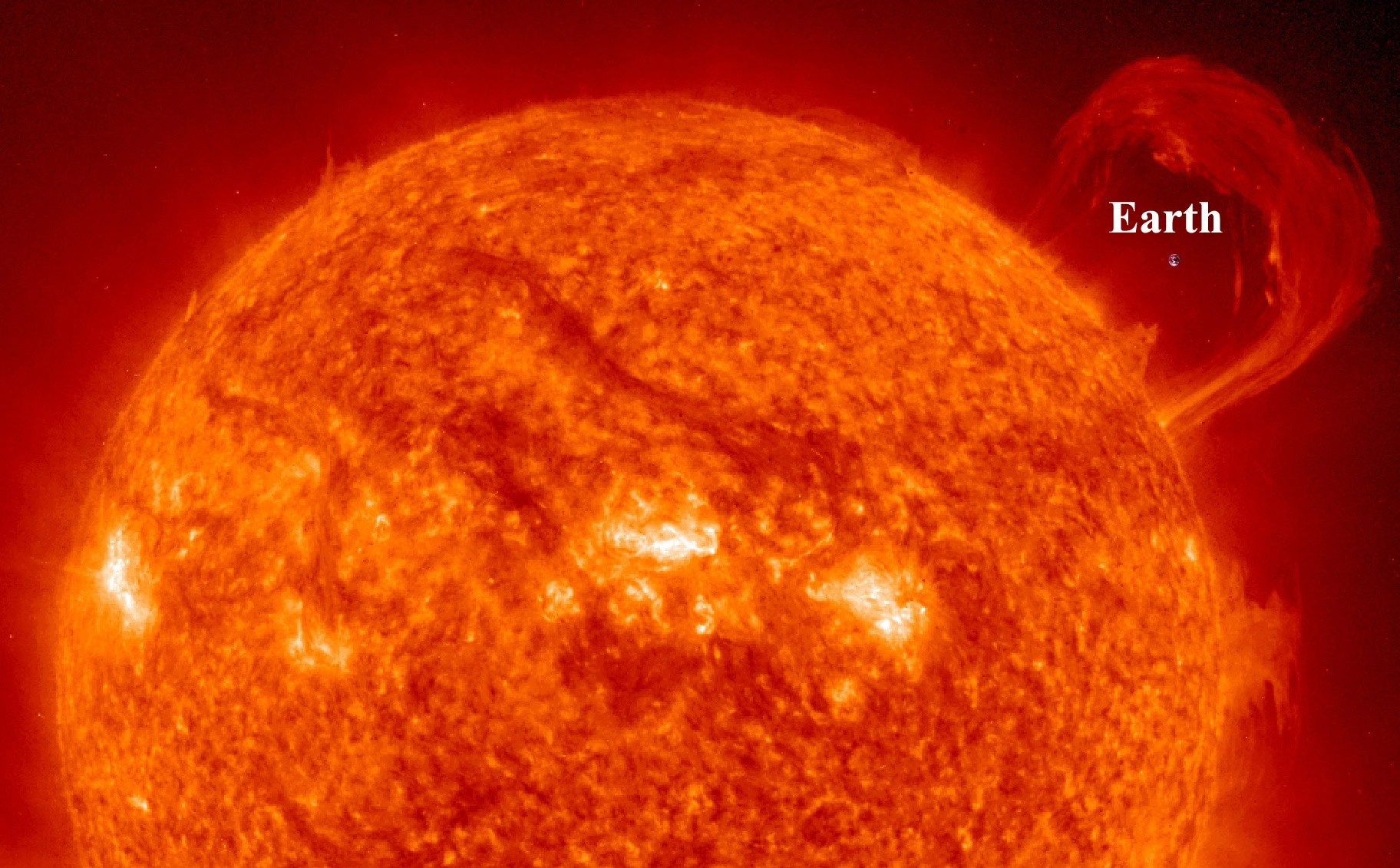
The oldest stories are written by the stars. Those luminous spheres radiate heat and light. They give life and meaning to the cosmos. Emerging from the formless, shapeless cloud at the beginning of time, the first stellar titans brought about the furnaces that forged the constituent ingredients. They define the chemical substances, warp spacetime, their evolution and life-cycle galvanised our world, our very bodies.
There are more stars in the cosmos than there are grains of sand on every beach and in every desert on our world. Stars are the broiling cauldrons from which new life is seeded, yet they are also the engines of the most violent phenomena.
In a calm neighbourhood, our star, the sun, is approaching its middle age. Carrying most of our system’s mass, this celestial orb’s ocean of fire shrouds a dense core. Like all stars, this core is the factory that maintains its existence. What we see and feel is the radiance of the core’s labour.
As with Prometheus’ gift of fire, so the light of the stars illuminates our understanding. Yet in unlocking the truth of these mysterious titans, what tales do they tell about our origins?
“As goodness stands in the intelligible realm to intelligence and the things we know, so in the visible realm the sun stands to sight and the things we see.”
— Plato
AD ASTRA
At the very beginning of time, the void was without form — an ocean of super-dense sub-atomic particles. Through inflation, this primordial soup cools, the atom’s constituent components came together, forming hydrogen. The big bang resonates with minuscule temperature variations that allow hydrogen to clump. The universe takes shape, structures form, and eventually, life.
Mass deforms the fabric of spacetime defining gravity. This attracting force allows two objects — whether galaxies, planets or atoms — to be drawn together. As mass increases, particles rush inward, coalesce into a hot dense cloud; a protostar. Soon, there’s enough heat and pressure to give birth to something new. With the ignition, the universe has light.
As soon as the sun fell, our tribal ancestors hid in caves, fearful of the night-predators. This was the relationship we shared with them. A mutual respect for the hunting ground that sustained us both.
But rarely was the night unreservedly black. Overhead, a ghostly moon waxed and waned amid a milky river twinkling with diamonds. Did this reflect the river of water that gave us life? Was it those falling points that devoured the land in ferocious flame?
The living flame eats and grows and consumes, yet we’ve learned to capture and tame it behind a ring of rocks. We emerge from the cave into illumination. Campfire banishes the night with a blanket of warmth and light. And deep into the night, we sit, we tell stories, we share ideas. We call the points ‘stars’; they flicker much like our fire. Perhaps these too are campfires, each trapped by rock. Perhaps, up there, are scattered many tribes. Are these our ancestors, passed to a higher realm to watch over us?
We give names to the patterns of stars. The Big and Little Dippers are cultural commonalities among many peoples. We see Orion (see image), the huntsman placed in the northern winter’s sky by Zeus. These great beasts and mighty warriors are our obsidian guardians. The narratives we weave and the myths we tell at the fire become locked in the heavens like the glue that bonds our tribe. ‘The myth is a way of making sense in a senseless world; narrative patterns that give significance to our existence’. And each new day, we bless the great burning sphere, held aloft by a solar barge, a great chariot. It is Ra, it is Helios, it is Tonatiuh. The bringer of heat and light, of spring and new growth.

As our stellar stories evolve, we settle from hunting and gathering; learning to tame animals and cultivate the land as we’d tamed the fire. Fiction and invention fuel our progress through wondrous tales. Cherished stars guide intrepid explorers venturing far from home. Points to anchor, paths to navigate, shapes to find home.
We’d believed our world to be flat; our minds wired to the environment from which we evolved. But as we explore natural laws, what makes sense is often far from true. We live on a large spherical rock which spins in a black ether at the heart of the celestial spheres, turning from the sun with periodicity to provide a view of the stars. Sharing a neighbourhood with a family of ‘wandering stars’ or planets.
Assembling glass within a tube to magnify distant light, Galileo Galilei uses this refracting ‘telescope’ to study the sky. He provides evidence to the heliocentric model; that our world orbits our sun, the master over a complex solar system.
“…I therefore concluded, and decided unhesitatingly, that there are three stars [moons] in the heavens moving about Jupiter, as Venus and Mercury about the Sun; which at length was established as clear as daylight by numerous other observations.”
— Galileo
It was the ancient Greek philosopher Anaxagoras who thought the sun was a hot piece of earth larger than the Peloponnese. Yet the sun is not a hot rock and is far bigger than the southern region of Greece. Through alchemy, the four ‘elements’ — fire, water, earth and air with a fifth quintessence of the universe — were deconstructed further. With fire, we melt, separate and fashion metals, mix chemical compounds, fusing them. And in all these, we see the flame scintillating in wondrous new hues. Our transmutation of elements leads to a new understanding.
Everything is constructed from an arrangement of atomic elements; heavier, denser materials sinking in water, lighter ones rising through the air. Dmitri Mendeleev devises a periodic table to define structure with the lightest, hydrogen crowning helium all the way to lead. With such regular formation, 92 spaces are rapidly filled by discoveries that power an industrial revolution.
“If all the elements are arranged in the order of their atomic weights, a periodic repetition of properties is obtained. This is expressed by the law of periodicity.”
— Mendeleev
Water is a compound of hydrogen and oxygen; the Earth, silicon-rich in metals; the air, an amalgam of oxygen, nitrogen and carbon dioxide. Fire is not an element but a plasma. None of the ancient Ionian ‘elements’ is an element at all!
Defining their chemical properties, the nucleus of each atom is a unique bond of protons and neutrons surrounded by an electron cloud. While the neutrons carry no electrical charge, the protons are positively charged. It is the equal negative charge of the electron cloud that holds the atom together as electrically neutral. Yet if protons are positively charged and like-charges repel, what keeps the nucleus together? This ‘strong nuclear force’ is the glue that acts over microscopic distances to overcome the electrical force that wants to wrench it apart.
Splitting light through a prism into a rainbow, chemical properties can be identified. The spectrograph of the stars reveals slender black bands corresponding to elements on the periodic table. Here, we see that the sun contains traces of carbon, oxygen and neon, but the key ingredients are hydrogen. And a discovery, Helium, named after the sun god, Helios.
Functioning by the same mechanisms, all stars are variations on our sun. Yet they are vast distances away. Even the closest — those visible by the naked eye — are so distant that standard measurements become meaningless. The next closest star, Alpha Centauri, is 4.37 light-years from us. Our galaxy, the Milky Way (from the Milk of Hera), is an island containing billions of stars. We are 27,000 light-years from the galactic core.
Early theories about the sun’s power-source — a hot nuclear-fission core like our planet — were disproven; if it were so, the sun would have been far younger than geologists were unearthing from dated rocks. But major advances in understanding the stars were yet to come.
THE LIFE AND DEATH OF DWARFS AND GIANTS
Our star is a seething cauldron born from a condensing nebula. A shockwave from a nearby exploding star sends ripples through this nebula, triggering a collapse.
A globule collects within a protostellar disc of dust. As mass increases, particle collisions produce vast amounts of heat. The inward pressure of gravity causes the core to ignite, switching the star on under the engine of nuclear fusion. This ignition puts a halt to the collapse and results in a titanic battle that governs the life of all stars — the inward crush in direct counterpoint to the outward radiative force generated at the core. Yet the star becomes stable once this balance is reached. An accretion disc of the remaining material condenses into planets and asteroids, the choreography of celestial mechanics keeping the children in orbit of their parent.
Stellar nurseries are lit from within by bright young light, yet once a star is formed, influence from other new stars pushes it from the nursery into its dark region of space.
What happens to a star during its life will depend upon how massive it is at birth. While stars smaller than our sun might form brown dwarfs, on the other scale, blue hyper-giants maybe millions of times bigger than our sun. Dwarfing many at 2 billion kilometres across, 9.26 billion suns are needed to fit inside the red behemoth VY Canis Majoris.
Yet these leviathans are crushed exponentially under their mass resulting in higher temperatures and faster rates of fusion. Labouring hard to maintain their existence, they shine brighter, burning through fuel in millions rather than billions of years, generating successive onion layers as the core shrinks. The hydrogen shell can burn for 10 million years with stacked furnaces of helium, carbon, neon, oxygen and finally silicon below. Each stage is steadily less efficient, finally forming an inert iron core.
In dwarf stars like our sun, once the hydrogen is consumed, the core collapses. Extra pressure and heat begin fusing helium to carbon and oxygen. Without the mass of larger stars, the resultant radiance pushes the shell away, diffusing the plasma into a nebulous cloud.
When this happens to our sun, it will expand to become a red giant, devouring the inner rocky gods of Mercury, Venus and possibly even the Earth. While this will spell the end for life on Earth, the ‘habitable zone’ will shift outward so that Mars or even some of Jupiter’s moons might sprout their evolutionary processes for life.
As the force of gravity continues to weaken, the star’s outer atmosphere will drift away, forming a planetary nebula. Unconnected to a planet, their greenish disc reminded Victorian astronomers of the planet Venus. Among the most beautiful objects in the heavens, rings of gas are lit by the ember of a white dwarf.
Even though a white dwarf might be the size of the Earth, it still retains half the mass of the sun and emits the same luminescence as a full moon. Inert, it is still incredibly hot, taking so long to cool that there are currently no black dwarfs in the universe.

Mammoth stars swell with age as the radiance from the shrinking core’s increasing temperature shoves against the outer laters. Yet, due to its tightly bound nucleus, once the core becomes iron, all fusion shuts down. Continued fusion consumes more energy than it radiates, and the star can no longer maintain its gigantic mass. In less than a second, the core collapses, turning an object a few million, to only a few thousand kilometres across. Unsupported, the outer layers tumble inward at ballistic speed. They rebound from the incompressible iron in a violent supernova; a shockwave blasting clouds of matter outward at thousands of kilometres per second. These become fields richly seeded for new life. The supernova generates so much energy that, for a brief period, it can outshine all the stars in its home galaxy. Sitting in the constellation Orion, Betelgeuse is nearing its end. If the sun was a tennis ball, the red giant would be the size of the London Eye. When it explodes, it will give us a night sky with a second moon.
After a supernova, the core may become a non-lustrous sphere known as a neutron star, one of the densest known objects. A teaspoon of neutron star might weigh 100 million tonnes. One of the largest resides in the constellation Torus; a mass approximately twice that of our sun is squeezed into an object just 25 kilometres across. On the star’s super-hard iron crust, there are even mountains. Yet these can only reach a few millimetres in altitude — perhaps the smallest, yet hardest mountains to ascend in the universe. The star’s name comes from the interior density where protons and electrons are squeezed into one another at unthinkable pressure, producing long strings of neutron-rich material fittingly called ‘nuclear pasta’.
One type of star flashes like a lighthouse as beams emitted from its poles sweep past Earth. These ‘pulsating stars’ are simply called ‘pulsars’. It was Jocelyn Bell Burnell who first detected the pulsar, whilst still a PhD student at Cambridge. The regular pulse seemed so artificial that on the printout, she wrote LGM-1 (or Little Green Men). This image is most commonly seen on the album cover for Joy Division’s Unknown Pleasures.
“…And it came ‘blip, blip, blip’. […] that was great, it was really sweet. It finally scorched the Little Green Men hypothesis because its highly unlikely there’s two lots of little green men at opposite sides of the universe, both deciding to signal […] at the same time, using a daft technique and a rather common-place frequency. […] The excitement was because this was a totally unexpected; a totally new kind of object, behaving in a way that astronomers had never expected; had ever dreamed of!”
— Bell Burnell


When binary neutron stars are locked in a marriage, immense mass draws them inexorably together. In the moment before they collide, they reach a significant percentage of the speed of light, sending gravitational judders across the universe. Tidal forces shatter the shells, the pressure differential releasing stupendous reserves of entombed matter. The resulting explosion is appropriately called a kilonova; the most destructive electromagnetic explosion in the heavens. Depending on their combined mass, the merger might collapse to a black hole.
A new understanding of these catastrophic phenomenon illuminates them as the source of the universe’s heavy elements. They seed gold and platinum and uranium into nebulas rich in lighter material, ready to coalesce. Embedded in new rocky worlds, waiting to be dug up and lusted over. Neutron stars, then, are another crucial piece in the complex tapestry that is the emergence of life from stardust.
In the core, temperatures reach tens-of-millions of degrees. Here, hydrogen loses cohesion. Liberated from the electron cloud, the particles buzz at colossal speed, greatly increasing the chance of collision. Atoms are thrown together until the electro-repulsion force is overcome and the nuclear strong force fuses them. Yet even here, the proton-proton chain can take 10 thousand years to successfully fuse hydrogen to helium. In a perpetual dance, partners come together to form deuterium (heavy hydrogen), fly apart, unite once more. It is a contained furnace, fusing 400 million tones of hydrogen into helium every second.
In the death-throws of titans, the gravitational mass is so strong that the core will collapse exponentially forming a singularity — more commonly known as a black hole. This is not a hole per se, but the impossibly dense remnant of a star where the immense pull of gravity prevents even light from escaping the event horizon. As nothing can travel faster than the speed of light, anything falling over this horizon, will never return.
Solving a problem with Newton’s gravity, Albert Einstein’s Relativity postulated the existence of a non-physical fabric to the universe where space and time are tightly bound into a single four-dimensional manifold. Anything with mass warps this fabric much like a bowling ball on a trampoline. As heavy objects spin, they rumple this fabric which wants to shift with the motion. Understanding this stretching, squeezing and rumpling of spacetime is vital for satellites like the GPS systems. Without daily error-correction for time dilation, these systems would fail.

Emitting no light, black holes are invisible, so they cannot be observed directly. Yet as the star collapses the rate of rotation increases, resulting in a ballistic spin-rate of black holes. This pulls nearby material into hot doughnut rings. The brightest known x-ray source, Cygnus X-1 was discovered to be a binary pair with a black hole pulling gas from its supergiant partner.
In popular culture, black holes have become synonymous with a great unknown danger. They are mysterious and powerful, yet may also be the source of galactic structure. Sitting at the epicentre of our galaxy in the constellation Sagittarius, a supermassive black hole has been detected. With stars zipping around its centre, we calculate a mass 4 million times greater than our sun. Now, the Hubble space telescope has detected black holes at the heart of all galaxies. Helping bind stars into galactic island-families, these hearts provide the fields for new star formation, and so, the evolution of the cosmos.
A hundred years after Einstein’s 1916 theory about gravitational waves, the collision of two black holes was detected by LIGO resulting in the 2017 Nobel prize in physics. The observatory measured the prorogation of a microscopic flex of spacetime through the Earth like sound-waves through air. These black holes collided more than a billion years ago, during the rise of multicellular life on Earth, their merger ringing like the peel of a great bell. As we are beginning to discover, the cosmos resonates with these mammoth oscillations. And for the first time, astronomy is no longer limited to sight alone; we can now listen to the cosmos.
As hydrogen fuses to helium, a newborn gamma-ray photon is ejected, its stalwart outward thrust counteracting the inward crush of mass. On its epic million-year journey, the gamma-ray’s energy is decreased to the more friendly visible spectrum. Finally, the photon reaches the photosphere, bursting into the long dark night. It will take a further 8 minutes and 20 seconds for the sunlight to clasp the Earth. Entering the atmosphere on a bright day it rebounds off an object and into our retina. A messenger particle to help us see and make sense of the world, and the stars above.
THE TAPESTRY
While the big bang created the homogeneous cloud of hydrogen, it was the stars, those forges of heavier elements — through their lustrous lives and titanic deaths — that created everything else. Without them, the oxygen in our air, the silicon underfoot, the carbon in our bones, the iron in our blood, none of these would exist. The universe nurtured life that could look back upon and know itself. As we look and listen to the cosmos, the story of our intrinsic inclusion in this great tapestry is revealed. We are the byproduct of the stellar lifecycle. We are stardust and our story is written among the stars.
Look at the stars! look, look up at the skies!
O look at all the fire-folk sitting in the air!
— Hopkins

BIBLIOGRAPHY
Bell Burnell, Jocelyn, Episode 1, in Beautiful Minds (BBC 4, Apr 2010)
Bolles, Edmund Blair, The Starry Messenger, in Galileo’s Commandment:
An Anthology of Great Science Writing (Abacus, 1999) p104
Bragg, Melvyn, The Life of Stars, in In Our Time (BBC Radio 4, Mar 2003)
Bragg, Melvyn, Nuclear Fusion, in In Our Time (BBC Radio 4, Oct 2014)
Dawkins, Richard, The Ancestor’s Tale: A Pilgrimage to the Dawn of Evolution
(Phoenix, 2004)
Diamond, Jared, The Third Chimpanzee: The Evolution and Future of the
Human Animal (Harper Perennial, 2007)
Hawking, Stephen, A Brief History Of Time: From Big Bang To
Black Holes (Bantam. 1989)
Hopkins, Gerard Manley, The Starlight Night, in Selected Poems
(Dover Thrift Editions, 2011) p 21
May, Rollo, Worldview: The History of a Concept, by David K. Naugle
(Wm. B. Eerdmans Publishing, 2002) p 298
Mendeleev, Dmitri Ivanovich, Lives And Times Of Great Pioneers In Chemistry
(Lavoisier To Sanger), ed CNR Rao and Indumati Rao (World Scientific
Publishing, 2016) p 123
Nobel Prize for Physics 2017
<https://www.nobelprize.org/prizes/physics/2017/summary/>
Plato, Republic in Oxford World Classics, translated by Robin Waterfield
(Oxford University Press, 1993) p 235
Roberts, Alice, Origins of Us: Human Anatomy and Evolution, Lecture, in YouTube
(University of Birmingham, Feb 2012)
<https://www.youtube.com/watch?v=x858bOny4Gw>
Sagan, Carl, Cosmos: The Story of Cosmic Evolution, Science and Civilisation
(Abacus, 1995)
Singh, Simon, Big Bang: The Origin of the Universe (Harper Perennial, 2005)
Weiss, Rainer, Einstein Was Right: Gravitational Waves 101, TEDx Talks in YouTube
(TED, Apr 2019) <https://www.youtube.com/watch?v=x7rjlm4SH5U>
Leave a Reply